 |
| Martín Ulysses Fuentes |
By Abel M. Salas
When Martín U. Fuentes launched his successful campaign for Cudahy
City Council as a first time candidate for office in 2022, he was
well-acquainted with the history of political scandal that had wreaked
havoc on local municipal governments across a region now commonly known
as South East Los Angeles, or SELA.
For years, beginning with a 2003 L.A. Times exposé
on then South Gate political operative Albert Robles, Jr., a tale fraught by charges of greed, graft and cronyism, Fuentes--and the rest of Southern California--had been steadily bombarded by
unflattering media coverage with respect to the area. Reporters often referred to L.A.‘s
southeastern suburbs as a “corridor of corruption,” a designation he
considered excessive and not entirely fair.
“I
was still in high school when I started hearing about Robles and the
shenanigans at South Gate City Hall,” says Fuentes. “Then it was (the
city of) Bell, which was actually worse and had been going on for much
longer. I know people now who still don't like to say they’re from
Cudahy or South East L.A. because of all that."
In
his opinion, the headlines from a part of the Greater East Side he has
called home for more than 40-years "had very little to do with the
neighborhoods, communities and small cities" he knew. None spoke of or
pointed to the “honest, hard-working people” responsible for the area's
revitalization once companies such as Firestone and GM had shuttered
their manufacturing facilities, leaving thousands out of work.
According
to Fuentes, they represented the “real” SELA and deserve credit for the
economic, social and cultural renaissance which continues to transform a
traditionally industrial, blue-collar sector of Los Angeles County. As a
result of their efforts, he and many of his generation “learned the
value of education and were taught to respect our elders as well as
those whose labor put food on our table and a roof over our heads,” says
the lifelong Cudahy resident and long-time small business owner.
It
would be interesting as well as worthwhile, Fuentes suggests, to track
just how much the transformation of South East Los Angeles has impacted
factors that now make L.A. County’s economy the 20th largest in the
world
Fluent in English and Spanish, Fuentes
was raised by a single mother who migrated to the U.S. from Central
America in the mid-'70s. Proud of his Latino heritage, he is equally
proud to say he is a son of Cudahy, the city which offered his mother
the opportunity to build a future. “My mom is from Honduras originally,” he says. “She cleaned houses for a living. Nevertheless, she always
made sure I made it to school on time everyday for 12 years because she
wanted something better for me.”
“Martín and I
have been friends for 25 years,” says Daniel Hernández, an ’80s-era
graduate of Garfield High in East L.A. “And from the very beginning, it
was always ‘Cudahy this’ and ‘Cudahy that,’” he says, attesting
to the civic pride at the root of the council member’s commitment to
public service. The negative news stories about Cudahy and its
neighboring cities, as Hernández recalls, “never sat well with him.” So when
when Fuentes made a bid for an at-large council seat, Hernández wasn’t surprised.
Among
the positive outcomes and quality of life improvements for Cudahy
constituents which Fuentes has been pleased to support during his tenure
as an emerging city steward is a $120 million multi-unit affordable
housing development for seniors. A groundbreaking for the Amanda Villas,
being built in partnership with National CORE, Prima Development and
partially funded by the County of Los Angeles, was held last September
on the Santa Ana Street construction site.
Almost
half of the 140 new residential units which the five-story structure
will add to housing stock in the area, says Fuentes, are earmarked for
seniors who are either unhoused or at risk of becoming so. The housing complex will also provide an on-site clinic which will make medical treatment
and care for residents more readily available.
As
a public servant, Fuentes says, his efforts have been guided by concern
for public safety coupled with a vision of Cudahy as a more walkable
community with reliable and affordable access to public transit. He also
considers himself a strong advocate for both small business owners and
youth.
 |
| Fuentes and new grandchild Emma Fuentes |
In Cudahy, Pop.22,000 (approx.) “the
median age is about 29,” Fuentes explains. Last September, he asked city
staff to examine the costs and feasibility of building a two-story teen
center at Lugo Park as part of a city-wide park improvements project.
Phase I of the recreational area renovations kicked off in May of this
year. The split-level teen center has yet to be approved.
“Just
because they aren't old enough to vote doesn't mean we, as elected
representatives and city staff, shouldn’t do our best to offer our
teenagers the kind of services, resources and opportunities that make
them proud of being from Cudahy and reinforce a successful transition
to adulthood," he concludes.
In a statement
announcing his intention to seek re-election in November, Fuentes
reiterated his eagerness to continue supporting initiatives that make
Cudahy a more pedestrian friendly city “with real destinations to walk
to.” Among these he lists “our new Sprouts, a newly remodeled Superior
Market, our very own Starbucks, the first Hasaki in the United States,
and Cuda Sushi.”
In the announcement, issued this week, Fuentes also vows to continue “fighting
for the funding and reopening of the Lugo Teen Center as a two-story
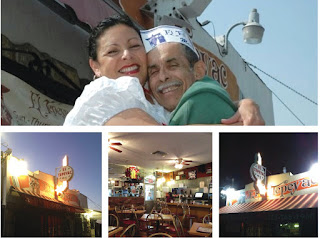
facility.” During a recent sit-down, outdoor interview at Lupe’s Burrito,
the legendary East L.A. eatery, he is candid. “It's been a tremendous
honor to serve the city where I was raised. And I couldn’t be more
grateful for the opportunity,” he says quietly as evening descends over
the Greater East Side.
Pausing a moment, he
turns his head to the right and looks up into the night. It is obvious
he has fixed his gaze southward, taking in the skies over Cudahy, seven miles away directly to the south of where he sits. Turning
his attention back to the conversation, his voice and smile suddenly
bright with enthusiasm, he says, “But there is still a lot of work to
do. So it’s time for all of us to roll up our sleeves.”
Editor's Note: To clarify, Boyle Heights is not part of nor can it be referred to as East L.A. It is, however part of what we have proudly designated the Greater East Side (GES), where the arts in general and Xicanx/Latinx arts have flourished with unbridled aesthetic rigor and unrelenting creative brilliance for over half a century. Here at Brooklyn & Boyle, we like to say that the Greater East Side stretches from the L.A. River to Riverside, where the undeniably world-class Cheech Marin museum is located.
With this profile in political courage, Brooklyn & Boyle is proud to resume it’s acclaimed coverage of GES communities and community arts as we launch “From the Greater East Side” as a regular feature here.--Abel Salas




Comments
Post a Comment